When we speak of Indian modern art, the name Jamini Roy shines like a lodestar. Born in 1887 in Beliatore, West Bengal, Roy emerged not only as a pioneer of modern Indian painting but also as a rebellious visionary — one who turned his back on European academic realism to embrace India’s indigenous traditions. Often dubbed “The Picasso of Bengal,” his journey from classical training to a radically simplified folk aesthetic was both revolutionary and deeply rooted in cultural pride.
Academic Beginnings and a Breakaway
Roy was formally trained at the Government College of Art and Craft, Kolkata, where he studied Western academic art under the influence of European realism. Early in his career, he painted portraits in oil with striking technical skill. But by the 1920s, Roy felt a growing disconnect — he yearned for an authentic Indian visual language.
Rejecting imported styles, he turned to the Kalighat paintings, Bengali scroll art, and the iconography of rural folk traditions, including Pattachitra and Terracotta reliefs — drawing inspiration from the world around him, not from European salons.
A New Aesthetic: Simplicity, Symbolism, Soul
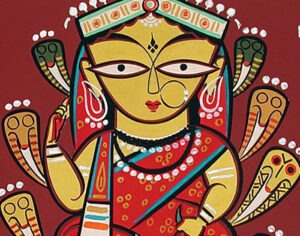
Jamini Roy’s mature style is instantly recognizable:
- Bold lines
- Flat, vibrant colors
- Almond-shaped eyes
- Geometric rhythms
- Use of natural pigments and earth tones
His subjects ranged from Santhal tribal dancers and rural mothers to epic characters like Krishna, Radha, and Hanuman — all depicted with a rustic elegance and spiritual depth. Each brushstroke was a deliberate return to India’s folk consciousness, making high art accessible and indigenous.
Why “The Picasso of Bengal”?
The comparison to Pablo Picasso is not about mimicry, but about spirit. Just as Picasso embraced African and Iberian folk influences to revolutionize Western art, Roy mined the soil of Bengal to create an entirely new Indian visual vocabulary. Both artists:
- Rejected formalism
- Embraced simplification and distortion
- Celebrated non-European forms
- Brought “low art” into elite spaces
Jamini Roy democratized art, proving that folk could be fine.
International Recognition and Enduring Legacy
Roy’s works were first exhibited internationally in the 1930s and ’40s in London and New York. He was one of the first Indian artists to gain global attention during his lifetime. In 1955, he was awarded the Padma Bhushan, and today, his paintings reside in:
- The Victoria and Albert Museum (London)
- The National Gallery of Modern Art (New Delhi)
- Private collections in Europe, America, and Japan
His legacy inspired generations of Indian artists to reconnect with local traditions and question the blind imitation of the West.