What began as a humble stitching technique to recycle old cloths in the villages of Bengal has now become a fashion statement on global runways. Kantha embroidery, traditionally done by women in rural West Bengal and Bangladesh, is a shining example of how folk art transcends boundaries, reinventing itself in contemporary design without losing its soul.
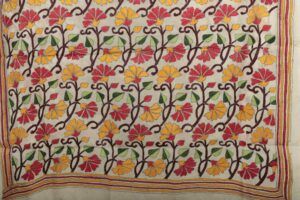
Kantha (pronounced kahn-thaa) refers to a style of hand embroidery involving simple, running stitches across layers of old fabric — usually cotton or muslin — to create soft quilts, throws, or garments. Historically, women reused old sarees, dhotis, and linens to make ‘nakshi kantha’ (decorative quilts), embedding stories of home, dreams, and community into every stitch.
Each piece is:
Kantha-making was not just craft — it was expression. Passed from grandmother to granddaughter, it preserved family histories, marriage stories, and even grief or hope through visual symbols. The embroidered layers were often used as:
The women behind these creations were rarely professional artisans — they were mothers, daughters, and homemakers, stitching their world into soft stories.
In the late 20th and early 21st centuries, designers and textile revivalists began to recognize the sophistication of Kantha embroidery. What was once domestic utility became high fashion and interior art. Kantha now appears in:
Kantha’s appeal lies in its handcrafted imperfection, its slow fashion ethos, and its story-rich visual language.
Kantha’s global demand has created new livelihoods for rural women, especially through:
Each Kantha piece sold supports not just heritage, but women’s empowerment, economic independence, and the revival of indigenous art forms.
Modern Kantha is dynamic. It adapts with:
Contemporary artists are also using Kantha as a medium to explore gender, environmentalism, and migration — stitching modern issues into ancient techniques.